




America's
Gulf Gateway
Find what you need
Powering Global Trade Through a Unified
U.S. Logistics Gateway
The Alabama Port Authority delivers one of the most direct global access points in the United States—anchored by the deepwater Port of Mobile and extended through a fully integrated network of inland river terminals, rail hubs, and the high-velocity MAX (Mobile America Express) service line. As the statewide logistics steward, we provide the strategy, infrastructure, and connectivity that accelerate trade flows, strengthen supply chains, and move cargo seamlessly from port to inland markets across the nation.
We empower every port and terminal in our system—coastal, inland, and intermodal—to operate with agility while aligning to a shared mission: expanding economic opportunity through world-class, multimodal logistics. When you work with the Alabama Port Authority, you’re not just accessing a port—you’re tapping into a coordinated, scalable, globally connected logistics ecosystem built for competitive advantage.
Mobile America Express
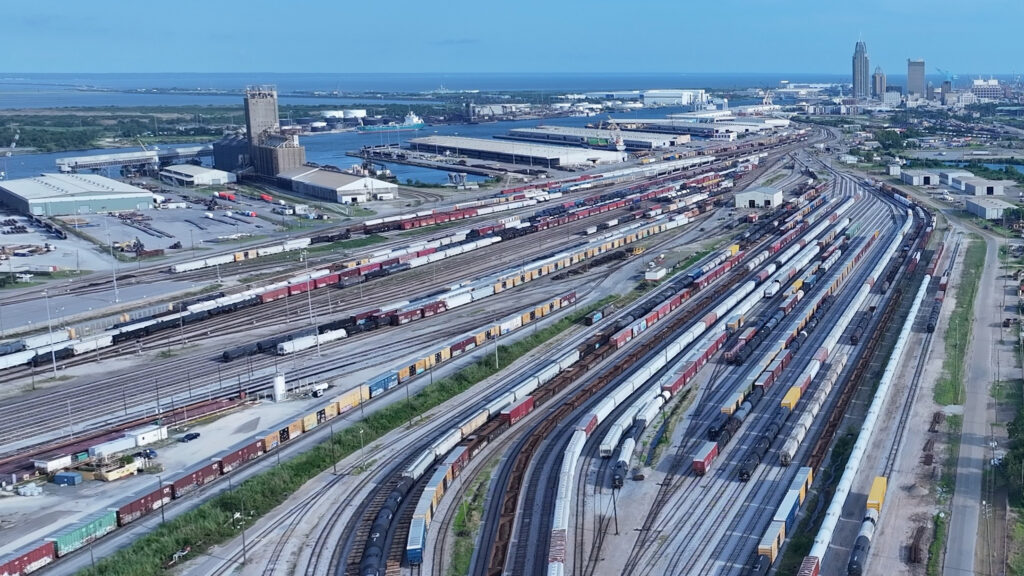
Born at the Port of Mobile and built for the Heart of America, MAX is the Alabama Port Authority’s high-efficiency freight corridor—connecting global trade to inland markets with speed, reliability, and scale. Powered by deepwater access, Class I rail, interstate highways, local air freight, and inland terminals, MAX delivers seamless logistics from port to production line.
Explore the Port
Facilities
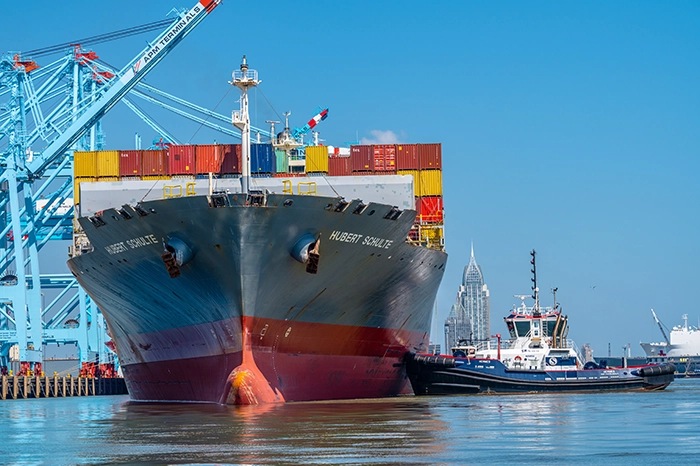
The Port of Mobile offers state-of-the-art terminals, deepwater berths, and modern infrastructure supporting global trade across diverse cargo sectors.
Solutions
Seamless connectivity through rail, interstate, and inland waterway networks ensures efficient, multimodal cargo movement from ship to shore to store.
About
As a vital Gulf gateway, the Alabama Port Authority connects inland markets across middle America to international commerce and opportunity.
Powering Alabama's Economy
One Shipment at a Time
From 2019 to 2024, marine cargo activity at Alabama Port Authority’s public and private terminals generated over $415.8 billion in total U.S. economic value delivered to our state. This extraordinary impact fuels Alabama’s economy—driving job creation, state revenue, and sustained growth for communities across the region.
From Scrap to Steel: How Smart Shipping Design Is Powering a Circular Economy in Alabama
In heavy industry, waste is often seen as a cost. But what if it could become a competitive advantage?
That’s exactly what’s happening in Alabama, where the Alabama Port Authority, Outokumpu, Clipper Bulk, and Alabama Steel Terminal (AST) have come together to rethink how steel scrap moves across borders—and back into production.
The Problem with Scrap
Scrap steel is difficult by nature. It’s bulky, irregular, and sharp enough to damage traditional containers. For manufacturers like Outokumpu, that creates a constant challenge:
- Scrap accumulates quickly
- Transport is costly and inefficient
- Standard containers aren’t built for the job
- Inland trucking typically requires one container per truck
And when vessels are already fully loaded with outbound steel, there’s no room for inefficiency.
Rethinking the Journey
Clipper Bulk, a leader in steel transportation operating vessels like the Lignum Matrix and Norse Mobile, saw an opportunity to innovate—working closely with AST and port partners to ensure the solution would function seamlessly beyond the vessel.
Instead of treating scrap logistics as a separate problem, they asked:
What if the container adapted to the cargo—and the entire supply chain?
The answer: collapsible steel containers.
“We wanted to create something that worked with the flow of global trade, not against it,” said a Clipper.
“The goal was simple—maximize every inch of space while improving efficiency from ship to terminal to truck.”
A Simple Idea, Engineered Brilliantly
These specialized 20-foot containers collapse flat when empty, allowing multiple units to be stacked in the space of one.
That innovation delivers a second, equally important benefit:
fewer truck moves.
Instead of hauling one empty container per truck, multiple collapsed units can be transported at once—reducing congestion, cost, and emissions.
Once the containers reach Mexico, they’re expanded and filled with scrap steel. Then they return to the Port of Mobile—this time carrying valuable raw material.
At AST, the containers are efficiently handled, staged, and routed inland to Outokumpu’s Calvert mill, where the scrap is melted down and reborn as stainless steel.
Why It Matters
This isn’t just a logistics improvement—it’s a smarter system end-to-end.
Efficiency
- Ships remain fully utilized in both directions
- Terminal operations are streamlined through AST
- Fewer truck moves required due to stackable containers
Durability
- Containers are built for the harsh realities of scrap steel
Sustainability
- Materials are reused instead of discarded
- Reduced emissions across both ocean and inland transport
The Alabama Port Authority sees this as a model for future supply chains:
“When partners collaborate at this level—including critical terminal operators like AST—you don’t just improve operations—you redefine them.”
The Bigger Picture
In an environment where industries are under pressure to do more with less, solutions like this stand out. They don’t rely on massive disruption—just smarter design, stronger collaboration, and better integration across every link in the chain.
Because sometimes, the most valuable resource isn’t what you ship out.
It’s what you bring back.
And in Alabama, that success is powered by collaboration—bringing together ocean carriers, manufacturers, terminal operators like AST, and the infrastructure of the Port of Mobile to turn complex challenges into scalable solutions.
Ready to rethink what your supply chain can do? Visit alports.com to learn more or connect with the team today at commerical@alports.com
Delivering for Alabama
By Doug Otto
Director & CEO, Alabama Port Authority
When most people picture the Port, they see ships along the waterfront and cranes rising over the skyline in Mobile. What they may not see is the bigger picture: the Alabama Port Authority connects all 67 counties in our state to the world through a vast network of infrastructure and supply chain assets.
“Delivering for Alabama” is more than a tagline. It is our mission.
Alabama’s only deep-water seaport is not simply a coastal asset. It is a statewide economic engine. And this week, we rolled out some new changes to strengthen this reality.
For decades, the Port of Mobile has been recognized as one of Alabama’s most powerful economic drivers. It will always remain our flagship gateway to global trade. But the system we operate today extends far beyond the waterfront. Through rail corridors, inland waterways, interstate highways, airports, and intermodal facilities, Alabama’s port network supports communities and industries across the entire state.
As our reach has grown, it has become essential that we reflect that broader responsibility.
To some, a brand update may seem cosmetic. For us, it represents clarity — about who we are and who we serve. The Alabama Port Authority exists to drive economic growth, connect global commerce, and strengthen communities across this state. Our refreshed identity makes that mission unmistakable.
Anchored by a new “A” icon, the updated brand symbolizes Alabama itself — stewardship, unity, and a commitment to serve the entire state. It reinforces that our responsibility is not limited to one city or one region. It is shared by every community that depends on reliable infrastructure to compete and grow.
Modern economic development depends on connectivity. Companies invest where they can move goods efficiently. Communities prosper when they have dependable access to markets. States succeed when their logistics systems are integrated, resilient, and forward-looking.
To better communicate how Alabama’s port, rail, roadway, waterway, and air connections work together, we introduced Mobile America Express, or MAX. This service platform organizes our multimodal strengths into a unified system that connects the Gulf Coast to the heart of America.
MAX is not a new direction. It is a clearer expression of what already exists — a coordinated network that links the Port of Mobile to inland Alabama and beyond. It highlights how our infrastructure works together to create opportunity statewide.
That opportunity is tangible.
Farmers in the Black Belt rely on export access to compete in global markets. Manufacturers in North Alabama depend on efficient supply chains. Steel producers in Birmingham, timber operations in Southwest Alabama, and distribution centers in Central Alabama all benefit from reliable connections to customers across the country and around the world.
When Alabama businesses can reach global markets, they grow. When rural producers can export efficiently, local economies strengthen. When advanced manufacturers have dependable logistics, they expand here rather than elsewhere.
Our vision is to position Alabama as a leader in global commerce by building the most efficient, innovative, and sustainable port ecosystem in the nation. Achieving that vision requires continued investment in infrastructure — and clarity in how we present our unified system to the world.
The refreshed brand ensures that when people hear “Alabama Port Authority,” they understand it represents a statewide network working on behalf of every Alabamian.
Delivering for Alabama means delivering opportunity — from the Gulf Coast to the Tennessee Valley and everywhere in between. It means ensuring that no matter where you live, your community is connected to the global economy.
Alabama Port Authority Launches New Initiative, Logo to Grow State’s Economy
New platform and logo reinforces Port’s role as a statewide economic driver and Alabama’s strategic position in the global supply chain.
MOBILE, Ala. — The Alabama Port Authority today announced a strategic brand evolution and the launch of a new service platform, Mobile America Express (MAX) — initiatives designed to strengthen the Port’s role as a catalyst for economic development statewide and promote Alabama’s strategic position in the global supply chain.
As Alabama’s only deep-water seaport and the gateway to a growing network of inland logistics assets, the Alabama Port Authority supports industries, communities, and jobs statewide. From farmers in the Black Belt to manufacturers in North Alabama and distribution centers in Central Alabama, the Port connects local businesses to national and international markets. The new MAX initiative and logo will serve to emphasize not just the Port’s strengths, but Alabama’s advantages in logistics, developable properties, and workforce capabilities.
Our responsibility is not limited to the waterfront in Mobile,” said Doug Otto, Director and CEO of the Alabama Port Authority. “We are Alabama’s port — serving all 67 counties — and our infrastructure supports economic opportunity in every corner of our state. This new focus highlights our strongest assets — the deepest container port in the Gulf, unparalleled connectivity through rail, highways, and inland waterways, and a workforce that can surpass businesses’ needs today and in the future.
The evolution includes a refreshed visual identity, a unified brand architecture that clarifies the relationship between the Alabama Port Authority and the Port of Mobile, and a fully redesigned website that better supports customers, partners, and communities statewide.
At the center of the rollout is a new service line called the Mobile America Express, or MAX, that organizes the Port’s multimodal capabilities into a single, coordinated platform. MAX connects deep-water access in Mobile with rail, inland waterways, highways, airports and intermodal facilities extending into the state and beyond.
MAX is not simply about moving cargo — it is about expanding opportunity and equipping partners statewide to sell the infrastructure assets that Alabama has to offer.
Through five Class I rail connections, the inland waterway system, air connections, and the convergence of Interstates 10 and 65, Alabama’s port system provides businesses across the state with competitive access to global markets. That connectivity strengthens rural exports, supports advanced manufacturing, attracts distribution investment, and reinforces Alabama’s position as a logistics leader in the Southeast.
“Economic development today depends on infrastructure,” Otto said. “That infrastructure is our greatest strength. When Alabama businesses have reliable access to global markets, communities grow, jobs expand, and our state becomes more competitive.”
The Alabama Port Authority continues to invest in terminal expansions, intermodal facilities, and inland connectivity, ensuring the state remains positioned for long-term growth in global commerce.
“Through this brand evolution and the launch of MAX, the message is clear: Alabama’s port belongs to the entire state and its benefits reach far beyond the Gulf Coast,” Otto said.