
In heavy industry, waste is often seen as a cost. But what if it could become a competitive advantage?
That’s exactly what’s happening in Alabama, where the Alabama Port Authority, Outokumpu, Clipper Bulk, and Alabama Steel Terminal (AST) have come together to rethink how steel scrap moves across borders — and back into production.
The Problem with Scrap
Scrap steel is difficult by nature. It’s bulky, irregular, and sharp enough to damage traditional containers. For manufacturers like Outokumpu, that creates a constant challenge:
- Scrap accumulates quickly
- Transport is costly and inefficient
- Standard containers aren’t built for the job
- Inland trucking typically requires one container per truck
And when vessels are already fully loaded with outbound steel, there’s no room for inefficiency.
Rethinking the Journey
Clipper Bulk, a leader in steel transportation operating vessels like the Lignum Matrix and Norse Mobile, saw an opportunity to innovate — working closely with AST and port partners to ensure the solution would function seamlessly beyond the vessel.
Instead of treating scrap logistics as a separate problem, they asked:
What if the container adapted to the cargo — and the entire supply chain?
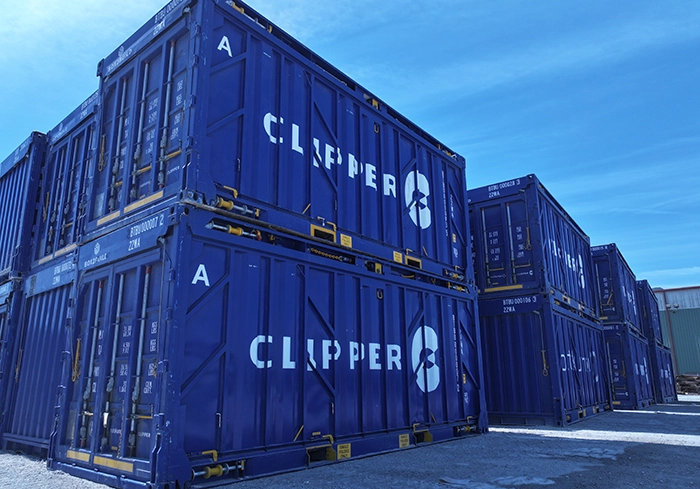
The answer: collapsible steel containers.
“We wanted to create something that worked with the flow of global trade, not against it,” said Clipper. “The goal was simple — maximize every inch of space while improving efficiency from ship to terminal to truck.”
A Simple Idea, Engineered Brilliantly
These specialized 20-foot containers collapse flat when empty, allowing multiple units to be stacked in the space of one.
That innovation delivers a second, equally important benefit:
fewer truck moves.
Instead of hauling one empty container per truck, multiple collapsed units can be transported at once — reducing congestion, cost, and emissions.
Once the containers reach Mexico, they’re expanded and filled with scrap steel. Then they return to the Port of Mobile — this time carrying valuable raw material.
At AST, the containers are efficiently handled, staged, and routed inland to Outokumpu’s Calvert mill, where the scrap is melted down and reborn as stainless steel.
Why It Matters
This isn’t just a logistics improvement — it’s a smarter system end-to-end.
Efficiency
- Ships remain fully utilized in both directions
- Terminal operations are streamlined through AST
- Fewer truck moves required due to stackable containers
Durability
- Containers are built for the harsh realities of scrap steel
Sustainability
- Materials are reused instead of discarded
- Reduced emissions across both ocean and inland transport
The Alabama Port Authority sees this as a model for future supply chains:
“When partners collaborate at this level — including critical terminal operators like AST — you don’t just improve operations — you redefine them.”
The Bigger Picture
In an environment where industries are under pressure to do more with less, solutions like this stand out. They don’t rely on massive disruption — just smarter design, stronger collaboration, and better integration across every link in the chain.
Because sometimes, the most valuable resource isn’t what you ship out.
It’s what you bring back.
And in Alabama, that success is powered by collaboration — bringing together ocean carriers, manufacturers, terminal operators like AST, and the infrastructure of the Port of Mobile to turn complex challenges into scalable solutions.
Ready to rethink what your supply chain can do? Visit alports.com to learn more or connect with the team today at commerical@alports.com