
The Alabama Port Authority plays a critical role as a logistics hub for the state’s steel industry — supporting both imports and exports that keep shipping moving efficiently. Alongside key partners including Outokumpu’s business area Americas (U.S. and Mexico), Clipper Bulk, and Alabama Steel Terminal (AST), the port continues to drive innovation in how steel moves through the supply chain.
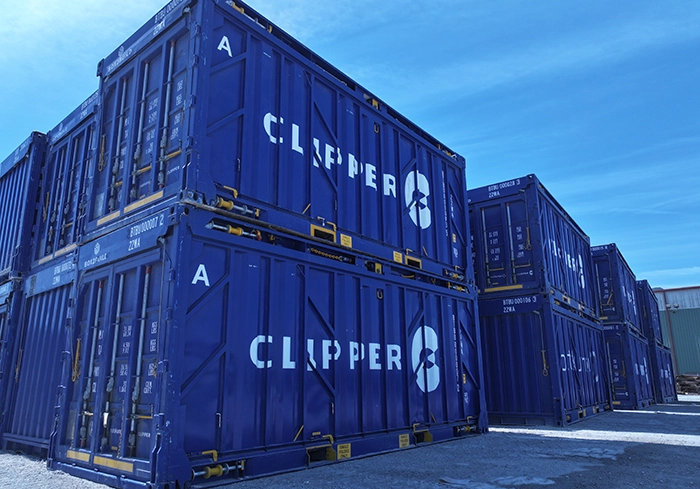
Outokumpu, headquartered in Helsinki, Finland, operates a major stainless steel mill in Calvert, Alabama, where sustainability and operational efficiency are central to production. As scrap steel volumes increased, the opportunity was clear: transform that scrap into new, high-value stainless steel. The challenge – how to bring an innovative style container onto the Calvert site without taking up too much space. The Clipper Bulk foldable containers now allow Outokumpu to unload their scrap and store the containers until they are ready to use again.
The Challenge
Scrap steel is notoriously difficult to transport. Its sharp, jagged edges can damage standard containers, create safety hazards, and increase handling costs.
At the same time, Outokumpu needed a solution that would not disrupt outbound shipments of finished stainless steel while alleviating the space constraints at the Port of Mobile. Shipping empty containers for scrap collection simply wasn’t viable; vessel space was already at a premium. Foldable containers provided the answer, enabling four containers to be stored in the footprint previously occupied by just one.
The Solution
Working collaboratively, Outokumpu, Clipper Bulk Shipping, and Box2Build developed a purpose-built solution: collapsible 20-foot scrap steel containers.
These containers were designed specifically to:
- Withstand the harsh conditions of scrap steel transport
- Collapse when empty to maximize vessel space
- Integrate seamlessly into existing shipping operations
- Improve port transportation efficiency by reducing truck moves
Clipper Bulk, known for vessels such as the Lignum Matrix and Norse Mobile, operates regular routes between Mexico, Europe, and the Port of Mobile. The Mexico route became the backbone of the new circular supply chain
“This wasn’t just about moving cargo — it was about rethinking how space and durability could work together,” said Clipper. “We designed a container that could effectively disappear on the outbound journey and perform under extreme conditions on the return.”
How It Works
- Outbound Journey (Fully Loaded Ships)
Collapsible containers are stacked — up to four at a time — in the footprint of a single standard unit, minimizing space usage. - At Origin (Mexico)
Containers are expanded (“popped up”) and filled with scrap steel collected from regional operations. - Return Voyage to Alabama
Loaded containers are transported back to the Port of Mobile. - Terminal Handling & Inland Transport
At AST, containers are efficiently offloaded, staged, and prepared for inland movement. Because empty containers can be stacked when repositioned, significantly fewer truck moves are required compared to traditional one-container-per-truck models. - Final Processing
Scrap steel is delivered to Outokumpu’s Calvert mill, where it is remelted and transformed into new stainless steel products.
The Impact
Operational Efficiency
- No loss of outbound cargo capacity
- Optimized vessel utilization
- Seamless integration into existing shipping routes
- Reduced port trucking requirements
Cost Savings
- Reduced need for dedicated scrap transport
- Lower container damage and replacement costs
- Fewer truck moves due to stackable empty containers
Sustainability Gains
- Closed-loop steel production
- Reduced raw material dependency
- Lower environmental footprint
Cameron Gibson, Steel Shipment liaison for the Alabama Port Authority, noted:
“This initiative showcases how infrastructure, terminal expertise, and industry partners like AST, Clipper, and Outokumpu can align to create smarter, more sustainable supply chains.”
Conclusion
By combining engineering innovation with coordinated logistics execution, Outokumpu, Clipper, AST, and the Alabama Port Authority transformed the way of working into a strategic resource.
This case demonstrates how thoughtful design — paired with strong terminal integration — can unlock circular economy solutions while improving efficiency across ocean and inland transportation alike.